
Climate Change Forum highlights how local actions can contribute towards global impact
This week we hosted elected representatives and council staff in Hobart for our Climate Change Forum with the theme Driving Action, Creating Change.
We first heard from Nikki Krushka, the Assistant Director of Climate Change (ReCFIT). She shared the impacts of climate change in Tasmania, which include sea level rise, longer fire seasons and increased heatwaves. Nikki also outlined the activities the Climate Change Office undertook in 2024, of which one was the release of Tasmania’s Risk Assessment for Climate Change. This identified 33 Tier 1 and 2 risks and opportunities across natural, built, social and economic domains. Also released in 2024 were the Emissions Reduction and Resilience Plans which include 30 new actions to be delivered across six sectors.

Our debate teams were passionate about questioning if councils should be prioritising climate risk and adaptation over emissions reductions. Malcolm Johnson and Dr Kathleen Beyer were arguing in the affirmative, noting that adaptation activities are cost-effective with high net benefits. Data shared by Dr Beyer identified that adaptation is inevitable and that it was important to embed climate risk assessments in planning processes. They also highlighted that the Tasmanian Government’s Future of Local Government Review identified that adaptation planning is best undertaken by councils in collaboration with communities.
Arguing against this was Sophie Hipkin and Matt Sullivan-Kilgour. Sophie shared numerous projects the City of Launceston has undertaken that tackled the root cause of climate change and recognised that councils have a direct influence on reducing emissions. This work also highlighted the many co-benefits of emissions reduction to improve the quality of life in communities. Matt followed up on this by acknowledging that mitigation actions permeate many aspects of council roles. The debate closed with Todd Houstein arguing that councils needed to focus on integrated climate action and not pit these two priorities against each other, a view that was held by those on both sides of the discussion and many in the room.
The local government leaders in attendance heard from the team at RACT who spoke about how insurance can be seen as a risk indicator. They noted that an increasing number of homes are becoming uninsurable due to climate risks, and those households would require government assistance after an emergency event. If we want to reduce the vulnerability within our communities, we need to change how we work and recognise what gaps can be filled with targeted mitigation initiatives. Our leaders also heard from Cr Jennifer Anderson from Macedon Ranges Shire Council, who is a chairperson of the Central Victorian Greenhouse Alliance and the newly elected MAV President. She discussed the implications of the changes to the Victorian Local Government Act, which now includes climate change as a council responsibility, and how these changes affect council operations. Additionally, Jennifer shared insights on how she, in her role as a councillor, could best facilitate climate action at her council.
Meanwhile, the attending practitioners heard from a range of inspiring speakers who have been engaged in climate action. Sharon Terry explained how Greater Shepparton City Council has been tackling climate change despite facing many challenges, such as project funding, gaining community buy-in and attracting skilled staff. To navigate climate action in a conservative political environment she has focused on aligning her language with leaders' values, which often means emphasising financial, economic or community benefits. Jason Smith shared his personal experience of connecting with Country and running workshops with landowners that teach the importance of caring for our land with traditional fire practices. Donna Luckman provided insights on the electrify everything campaign communications strategy undertaken by Merri-bek City Council which focused on sharing impactful stories as an effective method of driving action within their community.
After lunch, Dr Nina Rogers shared the results of her research project that looked at enabling climate-responsive governance in Tasmania’s councils. She asked research participants what motivates or hinders local government progress in climate adaptation, and what are the key elements to overcome the planning-to-implementation gap. Responses identified that council leaders often assign a low priority to climate change as they feel immense pressure from community members to respond to what they believe are day-to-day issues. Dr Rogers summarised that climate risk is not yet viewed as a central policy concern and whole-of-organisation responsibility within councils. She highlighted four key opportunities for local government, which include building knowledge, enhancing salience and strengthening governance to ensure decisions are made through a climate risk lens.
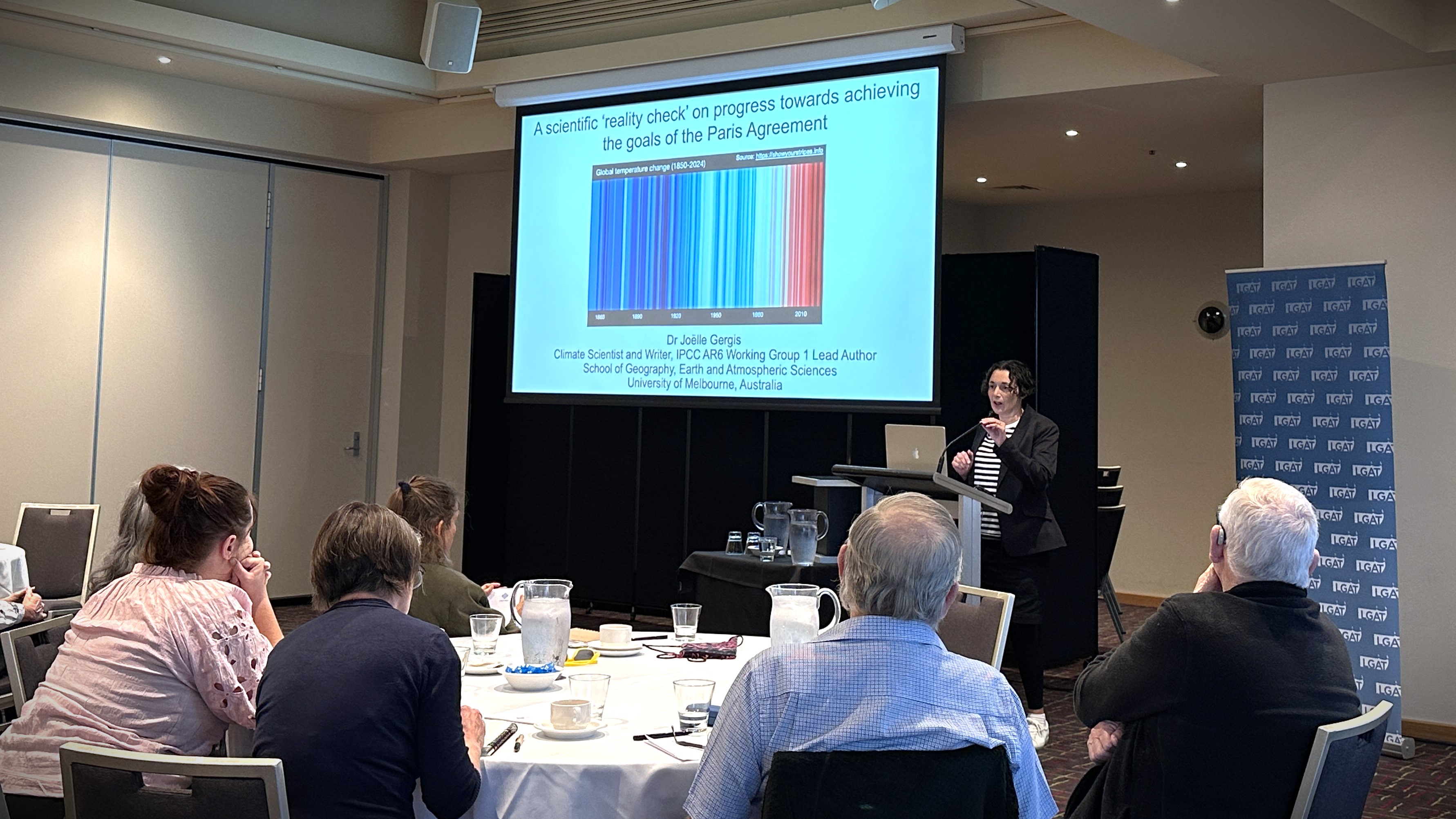
To conclude the day, climate scientist Dr Joëlle Gergis provided a sobering update on progress towards the Paris Agreement goals and the implications of climate change for Australia. As she shared alarming data with us, an ominous thunderstorm rolled over Hobart, perfectly setting the tone for the discussion. Unsurprisingly, 2024 was the warmest year on record which resulted in damage to 80% of the Great Barrier Reef.
Dr Gergis identified that achieving the 1.5-degree warming limit is unattainable with current government commitments and that we are heading towards a global warming of 3.6 degrees by the year 2100. She emphasised that Australia, being a hot and dry nation with extensive coastal infrastructure, is extremely vulnerable. A 2-metre sea level rise would devastate homes and infrastructure, while predicted temperature increases could make 50-degree summers the new norm, accompanied by more frequent heatwaves and bushfires. Dr Gergis urged action from government leaders and encouraged knowledge sharing between each other.
This forum highlighted that while climate change is a global issue, we can act locally to make change. Whether this is through emissions reduction, building resilience or communicating powerful messages with our communities. We look forward to continued collaboration with councils as we co-design a statewide local government climate capability program.
We are grateful to our speakers for sharing their valuable knowledge and data with us. Members can view some of these presentations on our Member Portal.